08/06/2015

Curwen Gallery Auctions: Now Open!

Our 2015 auctions are now open. The catalogues are available to view on The-Saleroom.com here. This year our auctions include 230 paintings and prints from the gallery collection.

Artwork in this years auction hanging salon style in the main gallery
As with previous years, there will be two auctions, both of which have online catalogues on The-Saleroom.com. One auction will take place online over a two week period (the 'Timed Auction') the other will take place in the gallery on the evening of 23rd June (the 'Live Auction'). All of the artwork in both auctions is currently on show in the gallery.
John Hoyland, Curwen Anniversary Print,
lithograph, Est. £200-300 (Retail value £900)

If you haven't been to our auctions before then you will be in for a treat. The annual auctions are, for good reason, one of the best attended events in our calendar and are an excellent place to buy artwork for a greatly reduced price. 


Associate Director Natalie Suggitt preparing the auction lists

Brendan Hansbro, Rejuvinated Unicorn,
wood engraving, 11 x 16cm, Est. £30-50
A few of our favourite pieces have been selected to be included in this years auction. With many reasonably priced works rubbing shoulders with more valuable, highly collectible works, there really is something for everyone in the auction. 


Donald Hamilton-Fraser, Launch Wash,
 screenprint, 69 x 53cm, Est. 300-400 (Retail value: £950)
The artwork for sale is a combination of classic lithographs by Modern British artists which we have acquired from Curwen Studio (often from big name artists such as Donald Hamilton- Fraser, Leonard Rosoman and John Piper) and more contemporary work from gallery artists. Estimates range from £5 to £2000 and cover all areas in between.
Albany Wiseman, Horseguards,
lithograph, 57 x 78cm, Est. £50-80 (Retail value:£250)
The auctions are always a great place to find high quality work at a reasonable price, whether you are a dealer buying for investment and re-sale or a new homeowner looking to cover your walls inexpensively. Last year many people also just turned up to see the event itself and then found themselves getting sucked into the bidding.

Alistair Grant, Sugar Suite Orange, lithograph,
 70 x 89cm (framed), Est. £200-300 (Retail value: £425)
There are always some fairly spectacular bargains to be had from the auctions with artwork often being sold for considerably less than its normal retail price (and even our very conservative estimates!).Obviously, the prices paid for lots depends entirely on who is in the room during the bidding.
Richard Walker, Move On Up, screenprint,
140 x 101cm (framed), Est. £300-500 (Retail value: £1100)
For more information on the auctions visit the gallery website  

12/05/2015

MARK CAZALET : ARTIST INTERVIEW


 7th-28th May 2015
Artist Talk: Tuesday 12th May from 6.30pm

Mark Cazalet is a new artist to Curwen Gallery. We decided to get to know the man and his works a little better …

Curwen Gallery: What themes and ideas were you hoping to communicate with the body of work which you will be showing in this exhibition?

Mark Cazalet: The classical unity of works produced in one place, at one time with one set of concerns; the arrival of the new day and its equivalent decline into darkness - moments of transformation.

Curwen Gallery: In the past you have said that your work is about “moments of transformation” – does your recent work explore these same ideas? Which experiences have inspired these works?

Mark Cazalet: The writings of Thomas Merton, a Benedictine Monk, who after a gadfly youth became a hermit in Gethsemani Monastery in Kentucky.  He wrote about the practice of meditational silence and the experience of nature as a divine teacher and inspiration.
Curwen Gallery: What is it about the depiction of nature that you find an appropriate vehicle for your spiritual ideas?
Magnificat Les Bassacs Wood Dawn II
chalk on coloured paper, 34 x 74cm(framed)
£950
Mark Cazalet: The history of Modernism and beyond is a radical separation from nature and concentration on the self-referential process of self-reflexive creativity.

That is a very worn down and claustrophobic arena.  As I teach in the beautiful locale of the Luberon Valley I encourage my students to not only work from what they see but spend time really seeing what is before them, it seemed natural that I should do the same.  The spiritual you ask about is probably just feeling at one with nature and thrillingly alive in this place.

Curwen Gallery: Do you feel that this recent body of work continues the tradition of English Romantic Landscape painting in a contemporary manner?

Mark Cazalet: I am very wary of any attempt to continue the tradition of English Neo Romantic or Romantic Tradition, despite being very influenced by both epochs.  We have to make work that comes out of our own period and neither rely on the collateral of others achievements nor the relevance of their work to their time.
Magnificat Les Bassacs Wood DawnV
chalk on coloured paper,34 x 74cm (framed)
£950
Equally we are formed by the traditions of our heritage and Romanticism is by no means worn out with its emphasis on the individual’s perception, and nature being an immeasurably precious source of inspiration as well as the means of our existence – these it seems are ever-truer realities today.  Perhaps for the first time there is an elegy to a passing fragile nature that will soon be mourned by the following generation.

Curwen Gallery: You have had a number of quite profound religious experiences. How have these experiences changed your world view and the artwork that you create?

Mark Cazalet: As my friend Timothy Winton replied when I asked him the same question: how does a fish feel about water?  The religious viewpoint is all I do and see, so I cannot imagine answering your question as if it weren’t there.  It is the element in which I exist so everything is religious. Re Ligare – to bind up a thing which is broken, a splint for healing.
Magnificat Les Bassacs Wood Dawn VII
chalk on coloured paper,34 x 74cm (framed)
£950
Curwen Gallery: Do you find that your faith can be problematic in the (largely secular) London art world? Do you think that this niche has created opportunities for you or not?
Mark Cazalet: It has caused me problems with specific gallery owners and certainly derailed one or two opportunities, probably for the best in hindsight.  I am not convinced that the Art World is secular, increasingly people (in private) follow all manner of eccentric, personalised, spiritualised belief systems.

In the 1980s it was different when a legacy of hard edged atheism ruled as a legacy of the radical political avant-garde.  Now commerce and hyper individualism, more corrosive ultimately, allow a broader inclusivity on the surface at least.  The problem comes with representing The Church as if one were an ambassador or preacher, neither of which I am- nor want to be seen as.
Les Basaacs Magnificat 5,oil on board, 17 x 24cm
£650

Curwen Gallery: How did your work develop during your experience of living in seclusion during the Albers Foundation residency? Is this the start of the body of work which you will be showing with us?

Mark Cazalet: The work I am showing with you prefigured the Albers work but also was its germination.  Josef Albers’ Interaction of Colour was a seminal text.  This is a very large question.  I am still working through the consequences of the two Albers Foundation residencies.
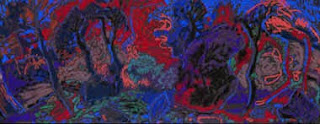
Nunc Dimitis Les Bassacs Wood Night I
chalk on coloured paper, 34 x 74cm (framed)
£950
 Curwen Gallery: Did you find the seclusion of the residency led you to produce less allegorical works? What is it that caused you to move away from the more figurative, myth inspired works which you are better known for?

Mark Cazalet: Colour has always been my chief pleasure and means of communication whether with figurative or in pure terms.  I simply sought to allow the experience of being still and opening my eyes to predominate.  Anni Albers said “let them speak,” meaning one’s materials.  I still have a way to go on that front and it seems the next step.

Curwen Gallery: Your, often controversial, ecclesiastical commissions form a large part of your opus. Do you consider them as a separate strand of working to the small pastel drawings that you will be showing with us? How are these two strands of working linked?

Mark Cazalet: The ecclesiological commissions and personal, biblically inspired works are as much a core part of me as the colour works.  Having a brief to fulfil and an architectural context to satisfy do load on the complexity, to say nothing of working with committees and patrons.  Obviously to walk alone and respond to whatever one sees is very wonderful in its freedom; a sacred flaneur.
 
Morning Light II
chalk on coloured paper, 38 x 30cm (framed)
£450
Curwen Gallery: The majority of your previous works are figurative drawings which re-interpret biblical mythology in a contemporary manner. What inspired this shift in your focus to the exploration of nature in a semi abstract manner?

Mark Cazalet: Actually neither: I have always had a semi abstract streak, which waxes and wanes, but certain shows such as The Museum of London’s Cathedrals of Industry or The Path to Calvary have stressed the most figurative side.  It really is all one, just different periods and themes.

Curwen Gallery: The wood and the tree are recurring motifs in your work. What are the references you are drawing from this symbol? Why is the tree and the wood a focus of your recent work?
 
 Mark Cazalet: Silent meditation requires a still place away from other people, or at least the intrusion from other people.  A wood is both an old image of an enclosed space in which to become lost and an increasingly difficult place to get lost in.  There are also aspects of Heidegger’s Lichtung; the momentary clearing in a dense space that allows for clear thought and perception.

Curwen Gallery: Are your more recent works inspired by poetry? What is it about poetry that you feel is valuable to your artwork? 

Morning Light IIIIchalk on coloured paper, 38 x 30cm (framed)
£450
Mark Cazalet: Poetry has always played an important role in my work, as has theatre and Opera.  All vehicles for staging ideas in a dramatic form.  But more than for the literal references. It is in the cadence, rhythm and irresolvable nature of the best poems that I find encouragement.

Curwen Gallery: You have travelled widely and done a number of artist residencies on Christian Pilgrimages (with Biblelands to Egypt, Palestine and Israel). What is it that the experience of travel and, most specifically, being on a pilgrimage that you find beneficial to your work? 

Mark Cazalet: The random and often infuriatingly inapposite timing of inspiration.  Routine is broken and the unexpected upturns ones normal practice.  Again increasingly it is not knowing what 
 one is to do that provokes the most creative response.

Magnificat Les Bassacs Wood Dawn VI
chalk on coloured paper, 34 x 74cm (framed)
£950
Curwen Gallery:How did your time studying under Christian Boltanski effect your work? How did this period relate to the period of work which you are currently making? 

Mark Cazalet: Christian was infuriating but several of the things he said took years to filter through and finally provoke a response.  He would present himself as a clown and yet slip in very difficult ideas that one couldn’t dismiss nor agree with; the artist as a bad preacher who pushes buttons to get a reaction but slips away without giving an answer, and the self- reflexive activity of making art, a self-awareness of what one is doing even whilst doing it.  I still greatly revere his paradoxical role as teacher who claims he has nothing to teach… 
Les Basaacs Magnificat 8,oil on board, 20 x 22cm
£650

Curwen Gallery: You studied at Chelsea and Falmouth colleges of art. Was this a crucial period of your artistic development. In what ways has your work changed since that time?

Mark Cazalet: I am closer to what I was doing on foundation than any other period since, a really warm feeling of coming home but not in the way I expected, nor the manner.


View the online catalogue for the exhibition here . Contact the gallery for sales enquiries.

08/05/2015

EMMA DUNBAR & FIONA MILLAIS

The paintings of Emma Dunbar and Fiona Millais share a common focus on coastlines and the natural landscape, with an interest in the everyday elements encountered in these places.

Emma Dunbar, Quiet Afternoon Harbour, 76cm x 46cm, acrylic on board, £1995


Emma Dunbar’s paintings aim to capture the essence of a place or scene. She is attracted to vivid colours and the decorative qualities in everyday objects, which she rearranges on the canvas to create a collaged aesthetic.  Birds, shells, flowers or fish which are often placed alongside painted depictions of the true landmarks. Her paintings are therefore more about conjuring an atmosphere of a place or situation, rather than literal transcriptions of the exact features of a location.

 
Emma Dunbar, Wild Summer Newquay, 91 x 61cm, acrylic on board,  £2950

She works mainly on board in acrylic, occasionally incorporating collage with gold and silver leaf. Many of her works reference traditional subject matter, such as the still life, with arrangements of flowers, jugs and fruit. 

Emma Dunbar, Rosey Curtains and Chickens
61 x 61cm, acrylic & mixed media on board,
£1600
Her vivid pallete and charactered style make these compositions feel very contemporary and uplifting. She draws inspiration from the work of favourite artists, including Mary Fedden, Milton Avery and Daphne McClure. 

Born in England in 1961, she graduated in 1984 with a BA (hons) in Fine Art Printmaking from West Surrey College of Art and Design. Since then she has worked full time as an artist and exhibited throughout the UK. Her paintings have been internationally reproduced as greetings cards, posters, limited edition etchings and even fabric designs.


Fiona Millais’ paintings are a representation of her memories of the places which inspire her. She grew up surrounded by the heather of the Surrey Hills and exploring the wild West Coasts of Scotland and Cornwall. Her memories of these places now inspire much of her work. Her paintings are often a response to her memories of landscapes and coasts.

 
Fiona Millais, These Days of Rain, 77 x 92cm, acrylic on canvas, £2995

She often works in layers of paint, leaving traces of earlier ideas visible, with layers of texture and colour suggesting interwoven history. Her paintings reflect her interest in the natural rhythms of the land and how it comes to show a human presence. These many layers within Fiona’s work reflect these ideas of man's impact on the landscape and how our actions leave marks which echo through time.
Fiona Millais, Bothy, acrylic on canvas, 51 x 51cm, £895

Fiona Millais studied Fine Art at the University of Newcastle upon Tyne, graduating in 1984. Her great-grandfather was the Pre-Raphaelite painter, Sir John Everett Millais.

28/04/2015

CURWEN GALLERY AUCTIONS


LIVE AUCTION
23rd June
ONLINE AUCTION
Ends 22nd June

It's almost upon us! The annual Curwen Gallery Auctions will be taking place this June. 
Sheila Jackson, Painted Elephants, screenprints 
 49 x 37cm, Est. £50-80s


This years auctions will be  following the same format as in the four previous years,  with one auction taking place live in the gallery (23rd June) and the other happening online (ending on 22nd June).


If you haven't been to our auctions before then you will be in for a treat. The annual auctions are (for good reason) one of the best attended events in our calendar and are an excellent place to buy artwork for a greatly reduced price.
John Hoyland, Curwen Anniversary Print,
lithograph, Est. £200-300 (Retail value £900)
Bidding in the online auction takes place exclusively online but the work is all available to view in the gallery. Bidding in the live auction takes place predominantly in the gallery (although bidding via a video link is possible online) on the evening of 23rd June.

Like the online auction, all the work is available to view in the gallery for the whole of the month of June. Both auction catalogues will be available to view online from early June.

Edward Bawden, Kew Palace, lithograph, 69 x 82cm (framed),
 Est. £500-700 (Retail value: £925)
We have just finished preparing the auction lists. We will be keeping the majority of the lists secret until they are officially published on TheSaleroom site in early June, however we can reveal a few of the treasures here...
Brendan Hansbro, Rejuvinated Unicorn,
wood engraving, 11 x 16cm, Est. £30-50
 In addition to those pieces pictured we will also be including: John Piper, North Grimstone (Est. £300-500, Retail value £1200) a number of prints and originals from Glynn Boyd Harte (ranging from £100-1000) two screenprints by Donald Hamilton Fraser (both estimated at £300-400, Retail value: £950). There will also be two classic unicorn prints by Brendan Hansbro (both estimated at £30-50) and plenty of Sheila Jackson's popular watercolours with estimates around the £50-100 mark.
Donald Hamilton-Fraser, Launch Wash,
 screenprint, 69 x 53cm, Est. 300-400 (Retail value: £950)
The work for sale is a combination of classic pieces which we have acquired from Curwen Studio (often prints from big name artists such as Donald Hamilton- Fraser, Edward Bawden and John Piper) and more contemporary artwork from gallery artists. Estimates range from £5 to £2000 and cover all areas in between.
Albany Wiseman, Horseguards,
lithograph, 57 x 78cm, Est. £50-80 (Retail value:£250)
The auctions are always a great place to find lovely work at a reasonable price, whether you are a dealer buying for investment and re-sale or a new homeowner looking to cover your walls inexpensively. Last year many people also just turned up to see the event itself and then found themselves getting sucked into the bidding with the pull of a bargain drawing them into the action.

Alistair Grant, Sugar Suite Orange, lithograph,
 70 x 89cm (framed), Est. £200-300 (Retail value: £425)
There are always some fairly spectacular bargains to be had from the auctions with artwork often being sold for considerably less than its normal retail price and even our estimates.In previous years we have even had legendary Curwen prints going for under £100. Obviously, the prices paid for lots depend entirely on who is in the room during the bidding.
Richard Walker, Move On Up, screenprint,
140 x 101cm (framed), Est. £300-500 (Retail value: £1100)
For the whole of June all of the items in the auction will be available to view in the gallery- with much of the work hanging from floor to ceiling. For that whole period, bidding can take place on the online auction (via TheSaleroom.com) and bids can be left with the gallery staff for the live auction if you can't be present on the night.
Gallery artist Bill Pryde admiring a Henry Moore print in our 2013 auction
On 23rd June interested bidders are invited into the gallery to place their bids at the live auction. Lots will be called from 7pm, with our star auctioneer Dominic Kemp running the operation from behind the gavel.
Dominic Kemp, Auctioneer.
Pictured in the film Miss Potter (2006. Pheonix Pictures)
Keep an eye on the gallery website for more information, which will be published as the date gets nearer...